
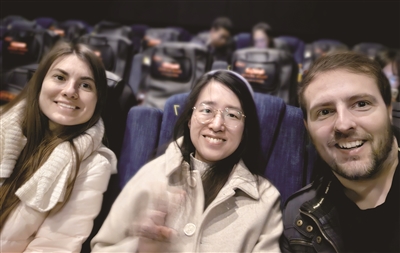
Ervins in cinema with his colleagues Photo provided to Hangzhoufeel
By Ervins Gorelovs
When I sat down in Hangzhou’s IMAX cinema on Feb 28 to watch the premiere of Flow, known in China as “猫猫的奇幻漂流”, I already knew it would be special. Not only because the film’s director and production team are from my home country, Latvia, where, with a population of 1.8 million, everyone literally knows everyone--likely contributing to the fact that I am fortunate to share the university with one of the film’s co-directors and producers in Riga--but also because I had invited my Hangzhou colleagues to watch the movie together. Here are three brief thoughts and observations.
Firstly, watching Flow on the big screen is impressive in itself. The visual style is distinctive. However, the exceptional audio experience elevated the storytelling to an entirely new level. To anyone considering watching this film for the first time, or perhaps giving it a second, third, or N-th try, I strongly suggest finding the best sound-treated venue possible. It truly makes a difference!
Secondly, as a Latvian living and working in Hangzhou, where I’ve been running a technology company deeply rooted in design for over five years, I’ve always emphasized “design” as a powerful communication tool--even a language in its own right. In the movie, despite animals being the main characters without any spoken dialogue, my colleagues and I still found multiple connection points and ideas to discuss. I find it remarkable how creativity can resonate with people worldwide, transforming contextual design into compelling storytelling that bridges offices, cities, countries, and cultures.
Thirdly, going forward, Flow shouldn’t be known solely for its global recognition and multiple prestigious awards, including a Golden Globe and the recent Oscar for Best Animated Feature Film. I think its creators have demonstrated that incredible art doesn’t always require enormous budgets (publicly available information notes that Flow had a production and distribution budget of around 3.5 million USD) or unique, proprietary tools. Created almost entirely with Blender, an open-source 3D software that anyone can download and learn, the film is a testament to what can be achieved through a harmonized approach of dreaming, communicating, and, most importantly, actually doing it!