
Photo by Chen Zhongqiu
On September 24, the finals of the “Creating the World · Sailing to the Future” Innovation & Entrepreneurship Competition for Overseas Talents 2026 Hangzhou will get underway. Now in its eleventh year, the Competition is once again approaching its grand finale—and Hangzhou is once again extending an invitation to innovative talent around the world.
Yet inside a factory in Linping District, a recently fulfilled order has already offered an early answer.
Robotic arms continuously pick, assemble, and test components—this is the latest deployment delivered by the team of Gaia Robotics. Its multimodal embodied-AI dual-arm robot recently secured a volume order from a leading local company. It is hard to imagine that all of this began with a competition just one year ago.
“Less than a year after establishing ourselves in Hangzhou, our technology had already moved from the lab to the production line,” recalled Dr. Zhang Xiaoxiao, the founder and a graduate of the Technical University of Munich, as she reflected on the 2025 finals. Gaia Robotics won first prize in the finals of the “Creating the World” Competition. With support and coordination from relevant departments of the organizing committee, the team subsequently partnered with a local chemical company, received backing from the Linping District Industrial Fund, and moved into China (Hangzhou) Computing Power Town. In a short period of time, the full chain linking technology, market, and capital was connected.
Her experience reflects the journey of many overseas-educated AI entrepreneurs in Hangzhou—from entering the Competition to putting down roots in the city. More than a competition, the event functions as a bridge connecting the entire process of attracting projects and talent, facilitating connections, supporting local establishment, and enabling long-term growth.
Casting a Global Net for Talent:
An Open Call to Innovators Worldwide
Since its launch in 2015, the “Creating the World” Competition has reached major innovation hubs around the globe, carrying Hangzhou’s invitation to talent worldwide. The Competition is hosted by the CPC Hangzhou Municipal Committee and the Hangzhou Municipal People’s Government, organized by the Talent Office of the CPC Hangzhou Municipal Committee, the Hangzhou Municipal Human Resources and Social Security Bureau, and the Hangzhou Municipal Science and Technology Bureau, with districts, counties, and county-level cities participating as special supporting partners. Over the past eleven years, the Competition has attracted more than 14,000 project entries from over 30 countries and regions, helped 409 projects establish operations in Hangzhou, generated more than RMB 3 billion in registered capital, and fostered 12 emerging unicorn companies, including Genlight Medical, Phlexing, Baili Technology, and LifeFoundry.
Over the past eleven years, the Competition has continuously expanded and refined its tracks. It began by soliciting projects only from North America, added a European division in 2016, and gradually built a global footprint. Specialized tracks in areas such as digital medicine, brain-inspired intelligence, and humanoid robotics were introduced over time, extending the Competition’s reach while sharpening its sector focus. In 2026, aligned with Hangzhou’s top priority of striving to become China’s premier city for AI innovation and development and centered on the city’s “296X” industrial strategy, the Competition established three major tracks: artificial intelligence, life and health, and advanced industries. These tracks cover AI computing power and data, embodied intelligence, vertical AI models, biotechnology, new drug development, high-end equipment, intelligent manufacturing, and other fields, drawing talent from around the world. This year, the Competition received 2,371 project applications from more than 30 countries and regions.
Finding promising projects is only the first step; identifying the right ones is what matters most. The Competition brings together leading local industry experts, academic specialists, investment institutions, and other stakeholders to evaluate entries across multiple dimensions, including technological innovation, team strength, market fit, and willingness to establish operations in Hangzhou. The goal is to ensure that every finalist can be effectively transplanted into Hangzhou’s business environment and closely matched with local industries. Among the 40 projects that advanced to the finals of this year’s main competition, 77.5% of participants hold doctoral degrees, 72.5% of the projects incorporate AI technologies, approximately 28.40% are at the pilot-testing stage, 29.99% have already entered the productization stage, and more than 70% have secured financing. Together, they form a highly promising pipeline of elite entrepreneurial projects.
Building Bridges:
Connecting Great Projects with the Right Resources
From the Competition itself through post-competition establishment, entrepreneurs consistently face the practical challenge of securing the resources they need to grow. To address this, the Competition’s organizing committee office has worked with Hangzhou’s districts, counties, and county-level cities to bring together high-quality entrepreneurial resources and create the “Maker Rainbow Bridge,” an ongoing, end-to-end matchmaking and support platform that serves as the primary vehicle for helping competition projects establish themselves locally. Policies, capital, business resources, and industrial-chain opportunities converge on this platform, allowing projects with needs and resource providers seeking opportunities to connect efficiently through this “bridge”.
Since this year’s competition began, the “Maker Rainbow Bridge” has hosted 21 events across Shangcheng, Xihu, Lin’an, Chun’an, Binjiang, Linping, Gongshu, Fuyang, and Qiantang, including 11 dedicated AI sessions designed specifically to connect AI companies with relevant resources. At the “AI Elite Program and Exchange Forum” in June, overseas-educated entrepreneurs working in embodied intelligence, large-model applications, AI chips, and related fields gathered for in-depth exchanges. Several overseas-trained professionals from Germany’s Max Planck institutes and the University of Cambridge brought their project teams to speak directly with local computing-power platforms and companies offering real-world application scenarios. In September, the Hangzhou AI Elite Program for Overseas Returnees invited Fang Yi, founder of Merit Interactive, to present “Data Intelligence in Practice and Explorations in Artificial Intelligence.” The program further focused discussion on emerging trends, helping participants clarify both their technology assessments and their paths to commercialization.
This bridge is more than a matchmaking channel. It has also become an important arena in which districts, counties, county-level cities, and major industrial parks compete to attract talent and projects. Many localities have introduced substantial, tailor-made incentive packages and actively showcased their offerings on the platform.
At the district level, support is both extensive and differentiated. Binjiang District integrates industrial, capital, and platform resources to create a smoother path for AI projects from R&D to market deployment. In early 2026, Shangcheng District became the first district in Zhejiang Province to introduce dedicated one-person company (OPC) policies. It launched a 20,000-square-meter move-in-ready OPC community and, together with the Hangzhou Scenario Innovation Center, pioneered the “Yingzhu (community operator)” model, creating a channel that connects the needs of large enterprises with the capabilities of individual startup operators. In doing so, Shangcheng has opened a “first stop in Hangzhou” for OPC entrepreneurs worldwide. Competition projects have shown strong establishment results in Shangcheng District, with 14 settling there in 2024 and 12 in 2025.
Industrial parks have developed distinctive approaches of their own. Alibaba Center · Xihu in Xihu District draws on the Alibaba and Ant ecosystems to connect projects with the technology, computing power, channels, and application scenarios of seven major healthcare business units. Through the “Xihu Medical Intelligence π” industry-university-research innovation consortium and the “Maker Rainbow Bridge · Qincheng Investment and Financing Exchange”, it provides high-quality projects with precise investment and financing matchmaking as well as full-lifecycle ecosystem support. The Competition among districts, counties, county-level cities, and major industrial parks to attract talent through the “Maker Rainbow Bridge” underscores the platform’s value: it does more than connect people and resources—it amplifies their value, helping strong projects find the right resources while ensuring that every sincere commitment is seen.
Creating the Right Environment:
From Move-In Ready to Putting Down Roots
Once projects and resources make their initial connections through the “Maker Rainbow Bridge”, the next step is to establish operations and put down real roots. Hangzhou’s entrepreneurial ecosystem—one that effectively says, “We’ll provide the sunlight and rain; you focus on growing”—has already persuaded many projects to make their choice through action: settling in Hangzhou.
For Li Yifan, head of Rongyuan Technology, the appeal lies in Hangzhou’s concentration of talent and computing resources, combined with Fuyang’s industrial foundation in precision machining and intelligent equipment. “We focus on intelligent sensing and attack-and-defense technologies. We conduct R&D in the central urban area and manufacturing in Fuyang. This ‘dual-location model’ gives us the most cost-effective setup.”
Yang Zhenhua, founder of Hangzhou Qize Wanjing, which focuses on tactile sensing for embodied intelligence, said that setting up in Hangzhou “really is different”, with business registration requiring almost no in-person visits. What impressed him most was the city’s entrepreneurial atmosphere: “You can sit down in almost any coffee shop and end up talking about the latest trends in artificial intelligence.” That combination of pragmatism and energy became a key reason for him to put down roots here.
Hangzhou Fuyue Pharmaceutical Technology focuses on an AI-driven platform for developing new ophthalmic drugs. Chen Hao, head of public affairs, is leading the team in a joint research effort with a local ophthalmic pharmaceutical company on dry eye disease. “Zhejiang University School of Medicine and Wenzhou Medical University’s School of Ophthalmology and Optometry both have a strong presence here. The talent pool itself is a scarce resource, and the business environment and policy support are also in place,” he said. “At the intersection of AI and the life and healthcare, Hangzhou is an especially strong fit.”
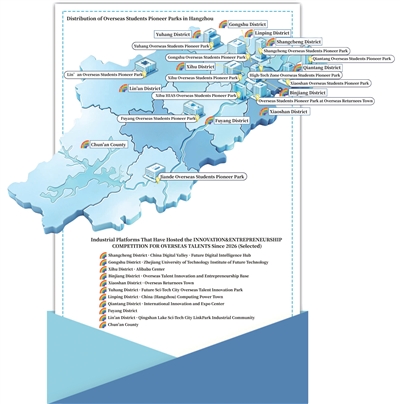
At the same time, Hangzhou has continued to develop its entrepreneurship parks for overseas-educated professionals. By deepening innovation in incubation models, strengthening policy support, facilitating access to financing, and cultivating industrial ecosystems, these parks have successfully attracted and concentrated internationally minded, innovation-driven returnees. They have also helped foster a group of technology companies with strong core competitiveness, injecting sustained momentum into regional innovation and providing meaningful support for Zhejiang Province and the broader Yangtze River Delta.
The Hangzhou Overseas Returnees Town Entrepreneurship Park is a representative example of this transformation. In 2023, it was officially recognized as a municipal-level entrepreneurship park for overseas-educated professionals and serves as the core hub of Overseas Returnees Town. The park has planned 2 million square meters of industrial space, more than 1 million square meters of which has already been completed, supporting technology companies throughout their entire lifecycle—from early-stage incubation to mature growth. Chao Ran, founder of LifeFoundry; Zhou Kai, founder of Jiaozhi Biotechnology (Hangzhou); Dong Min, founder of Bo’an Shining Biotechnology (Hangzhou); and many other overseas-trained PhDs have put down roots here through the Competition, leading young teams in exploring the frontiers of science and technology. Entrepreneurs with overseas study experience account for as much as 72% of the park’s founders, while AI-related companies have become one of its fastest-growing segments. To ensure that talent can be attracted, retained, and supported in long-term development, the park offers comprehensive amenities, including an international community, international schools, and neighborhood service centers. Its dedicated “Ten Measures for Overseas Returnees” policy covers ten key areas—from settlement incentives and school enrollment support for children to industrial-fund backing—creating a complete ecosystem that connects everyday life with entrepreneurship.
The Xihu HIAS Entrepreneurship Park for Overseas-Educated Professionals, unveiled during the 2025 competition finals, is a high-level incubator for frontier technology industries jointly developed by the Hangzhou Institute for Advanced Study, University of Chinese Academy of Sciences, and Xihu District. Known for its one-stop, highly hands-on science and technology services, the park is home to companies whose leaders—nearly half of them with overseas study experience—are working in advanced fields such as chip and sensor manufacturing and innovative drug development. A new hub of innovation is rapidly taking shape.
Supporting Growth:
The Journey Continues Beyond the Awards Stage
For companies to truly take root and accelerate in Hangzhou, a single moment of recognition at a competition is never enough. Behind their growth are two reinforcing forces: the organizing committee and special supporting partners, which continue to facilitate and support projects after they establish operations locally; and the strength of Hangzhou’s AI and other key industrial ecosystems, built up over many years. Together, these forces enable entrepreneurial ventures to keep growing long after the Competition ends.
Liu Min’s story began with an “eye”. He developed a biomimetic vision chip that integrates sensing and computing and responds nearly 1,000 times faster than conventional solutions. The technology earned him second prize in the 2024 competition finals, after which he founded Hangzhou Dongwei Vision Technology Co., Ltd. in Shangcheng District. Within a year of establishing the company, the team quickly secured partnerships with multiple local companies. In his view, what truly helped the company gain a firm foothold was not simply the trophy: “In Hangzhou, support doesn’t end after a single service. There are always people following up and helping move things forward.”
Xie Tunyang, a Cambridge graduate born after 2000, brought a world-first electronic-skin technology for EEG signal acquisition that makes traditionally bulky EEG equipment lighter and more comfortable. In 2025, his brain-data infrastructure project advanced to the finals of the humanoid robotics track and placed among the top six. He then founded Hangzhou Naojing Yuanqi Technology Co., Ltd. in Shangcheng District. After establishing operations, the team simultaneously advanced its core patent portfolio and built deep partnerships with leading EEG laboratories in China. Xie attributes this rapid progress to the combined effect of Hangzhou’s dense talent pool and efficient business services.
Chao Ran’s story stretches further back. A second-prize winner in the 2018 competition finals, he is now the founder of the emerging unicorn LifeFoundry. His field, synthetic biology, has increasingly converged with AI in recent years. He still remembers the company’s early days in Hangzhou. At the time, it happened to qualify for policy support, and “in many cases, the talent office reached out to us proactively to make the connections.” Instead of the company having to chase policies, the policies came to the company. Through the Competition, he later received key support under Binjiang District’s “5050 Program”. Today, the company’s independently developed “Darwin” intelligent and flexible biofoundry system uses AI algorithms to optimize experimental design and has entered into collaborations with multiple Fortune Global 500 companies. Chao sums up his assessment in a few words: “This is where one of the most dynamic entrepreneurial ecosystems has taken shape.”
“Continuous follow-up” is not just a slogan; it is backed by a concrete set of mechanisms. Funding is often the first major barrier startup teams encounter. Algorithm iteration, computing-power procurement, and real-world scenario validation all require substantial spending. To address this, the Competition has established a dedicated venture capital fund and built extensive connections with leading venture capital institutions, helping many projects avoid a funding gap after their angel rounds and continue receiving follow-on investment. At the same time, programs organized and facilitated by the Competition Committee—such as the “Maker Alumni Association” and “Maker Pioneer Camp”—help connect AI projects with leading local companies for supply-chain collaboration and joint technology development. As one entrepreneur put it, “When you work on a project overseas, you often have to knock on doors one company at a time to find resources. Here, by the time you finish a cup of coffee, you may already have met partners both upstream and downstream.”
Support extends thoughtfully into everyday life as well—from the regularly updated Handbook for Overseas Returnees’ Growth, to the now well-established “620 (June 20) Hangzhou Overseas Returnees Carnival”, to ongoing policy briefings and industry matchmaking events. The message is simple: Hangzhou offers not only opportunities, but also reasons to build a life here with confidence.
The broader appeal of Hangzhou’s industrial ecosystem provides the deeper foundation that makes entrepreneurs want to stay. A strong concentration of core AI industries, abundant computing resources, a dense network of leading companies, active capital markets, and a wealth of universities and research institutions all reinforce the Competition’s support system. The two work in tandem, and neither can fully succeed without the other.
An Innovation Rainforest:
Cultivated with Patience
A city may attract talent with opportunity, but what truly makes people stay is an ecosystem. By linking policy, capital, industry, talent, and quality-of-life services into a continuous support chain—from finding talent, to helping it stay, to supporting its growth—Hangzhou has built the approach it has pursued for years. This is also the underlying logic behind the city’s sustained ability to attract talent.
From taking the stage at a competition to starting production on a factory floor, from receiving a certificate to securing a purchase order, these entrepreneurs have followed different paths. Yet in the same environment, they have found a similar rhythm of growth: there are partners ready to support their technology, capital available to keep pace, industry connections that can bring them into real markets, and services that provide stability in everyday life. This may be what sets Hangzhou apart from other cities—it offers not only opportunities, but also greater certainty that entrepreneurs can carry those opportunities all the way through.
The numbers speak for themselves. Hangzhou is now home to more than 100,000 people who have returned from studying abroad, and overseas-educated entrepreneurs have founded more than 3,000 companies in the city, nearly 50 of which are publicly listed. Hangzhou has ranked first in China for the net inflow rate of overseas talent for multiple consecutive years and has been named one of the “Most Attractive Chinese Cities for Foreign Talent” for 15 consecutive years. According to the World Intellectual Property Organization’s 2026 Global Innovation Index ranking of the world’s top 100 innovation clusters, Hangzhou ranks 13th globally, remaining in the global top 13 for the second consecutive year.
From “Creating the World” to the “Maker Rainbow Bridge”, from the rapid growth of entrepreneurship parks for overseas-educated professionals to one vivid startup story after another, Hangzhou has spent eleven years demonstrating what it means to truly attract talent: creating a place where people want to stay, are able to stay, and have room to grow.
This year’s competition will add another promising chapter to Hangzhou’s efforts to build itself into a city friendly to employment and entrepreneurship and a leading city for AI innovation and development. Yet the longer-term answer may already be visible in the trajectory of the past eleven years: as more and more entrepreneurs choose Hangzhou as the starting point for their ambitions, the City is moving—with sustained patience and commitment—toward a future shaped by innovators.