
Society
By Jin Yingying
The recently approved "The Regulations on Promotion of the Testing and Application of Intelligent Connected Vehicles (ICVs) in Hangzhou City" by Zhejiang Provincial People's Congress will take effect on May 1, 2024. Hangzhou is the first city outside China's special economic zones to establish legislation for autonomous vehicles, marking as a leader in low-speed unmanned vehicle regulation.
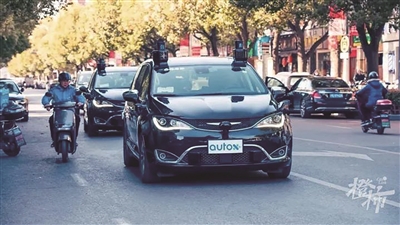
The regulations herald a new era for Hangzhou, with more intelligent connected vehicles (ICVs) traversing its roads and streets, transforming local lifestyles.
The city's autonomous vehicle industry has seen a surge of innovative strategies across its districts and counties as they compete to lead this emerging sector.
Shangcheng District has established two ICV routes in central urban areas, linking the Citizen Center to Hangzhoudong Railway Station and Xiaoshan International Airport. It has been designated a pilot area for ICVs, with a focus on integrating these technologies in central business districts and science and innovation sectors.
Meanwhile, Binjiang District has initiated an innovative autonomous vehicle program, launching Hangzhou's first L4 autonomous driving experience on open roads. L4 autonomous vehicles can operate without a driver in specific environments.
Yuhang District has introduced autonomous buses to serve residents and employees in Hangzhou Future Sci-Tech City. It has also launched a district-level policy for an "integrated aerial and ground economy", providing subsidies of up to five million yuan per year to companies obtaining a full unmanned license.
In Qiantang District, unmanned vehicles are already delivering parcels, representing a significant move towards commercializing unmanned vehicle operations in Hangzhou.
As Hangzhou rapidly becomes a benchmark city for ICVs, it has developed an industry layout with one core (Qiantang) and three hubs (Binjiang, Xiaoshan, and Yuhang). With an industry exceeding 200 billion yuan, the city aims to set the national standard for "vehicle-road-cloud integration", a model system expected to revolutionize urban transit and pave the way for intelligent urban transportation systems.
Hangzhou has also created a safety monitoring platform for ICVs, designed to collect and analyze data from public road tests to refine vehicle safety standards.